
Set Up Advanced Chat Routing in Knock AI

Written by Knock Team • Last updated: Oct 31, 2025 • Version: v1.0
Who this is for: SDR Managers, Sales/RevOps, Marketing Ops
Use Knock AI to define exactly how every type of inbound lead should be handled - by your top reps, by AI, or not at all. You segment your audience by ICP fit, company attributes, intent, CRM data, attribution, and more, then assign a distinct routing and qualification flow to each group. The AI agent enforces those rules in real time on every chat, so the right lead always lands with the right person, and your team never wastes time on leads that don't belong in the pipeline. *This page covers chat routing. For calendar handoff and availability rules, see Meeting Routing in Knock AI
What Chat Routing Does (at a glance)
Most chat tools send every lead to the same queue and let reps sort them out. Knock AI works the other way around: you define exactly which type of lead deserves which experience, and the AI enforces that on every single conversation, instantly and without rep involvement.
The core idea is audience segmentation with a dedicated flow per group. You carve your inbound traffic into distinct groups based on whatever criteria matter to your business, company size, industry, territory, CRM status, intent type, UTM source, deal stage, or any custom field you define, and then assign each group its own outcome. Your top ICP accounts get connected to a named rep immediately. Mid-market or unowned accounts get warmed up by the AI agent before a human steps in. Leads outside your ICP get handled and disqualified by the AI entirely, no rep time wasted.
What makes this genuinely powerful is the custom qualification layer. Beyond built-in firmographic and behavioral signals, you can define your own qualification fields - budget range, use case, products of interest, contract renewal date, number of locations, anything your team actually uses to qualify - and Knock AI will enrich this data automatically. If the data isn't available, the Discovery Agent asks the lead directly, in natural conversation, and uses the answer to route them correctly. Your qualification logic, run by AI, on every chat.
- Segment by any criteria your team uses. Company size, industry, territory, intent, CRM ownership, attribution data, HubSpot/Salesforce fields, or fully custom qualification fields you define.
- Assign a different flow to every group. Some groups go straight to a human rep (or a round-robin team). Others go to the Discovery Agent for AI-led qualification. Others get disqualified by the agent automatically - rejected, closed, no rep involved.
- The AI detects intent before routing fires. Knock's agent identifies the visitor's intent from the very first message - buying, support, career, or partnership - and applies the right routing tree for that intent.
- The Discovery Agent is the enforcement layer. It opens every chat, evaluates the lead against your segments, gathers any missing qualification data by asking the lead directly, and routes accordingly. If configured, the agent can also suggest actions such as book a demo and signup tp the product
How Chat Routing Works in Knock AI
- Intent detection comes first - Before any routing segment is evaluated, Knock's AI agent identifies the intent behind the conversation. Every incoming chat is classified into one of four intent types - Buying, Support, Career, or Partnership - and routed into the corresponding flow.
- Audience segmentation drives the routing - Within each intent flow, you define routing priority segments, each one representing a distinct audience group. Segments are evaluated top-to-bottom; the first one that matches determines the lead's entire experience. You build a segment by combining conditions: "Company Size is 201–1000 AND Industry is SaaS AND Country is United States." You can layer as many conditions as needed. The segment then fires one of three outcomes:
- Human Rep - the lead is routed to a specific rep or a round-robin team. This is relevant when you have a rep owner for each audience type. The agent engages the lead until the rep joins the chat.
- Discovery Agent - anyone in the Monitoring channel can jump in. The first to reply becomes the owner. This is relevant when a group of reps can talk to a specific audience, and the first to reply wins the lead.
- Disqualify - the AI handles the full conversation and updates the chat as rejected. The lead gets a self-service experience. You can still see those chats, and if you decide to join, the status changes to Human discovery.
- Custom qualification fields: route on any criteria you define - Beyond the built-in filters, you can create custom qualification fields, entirely your own criteria, defined in plain language.
Leads that don't match any segment fall into your Fall back routing rule - a catch-all destination you define to make sure nothing goes unhandled.
When you create a custom filter, you define three things: the field name (e.g. "Budget range"), the question the AI should ask the lead if the data is missing (e.g. "What budget range are you considering?"), and the expected answer format (a number, a dollar amount, a date, a location, or one or more options from a list).
When a chat starts, Knock AI enrich the lead and try to get this data automatically. If it's already there, it uses it to evaluate the segment instantly. If it's missing, the Discovery Agent asks the lead directly - naturally, in conversation - and then routes based on their answer.
This means your routing logic is not limited to basic enrichment. You can qualify on budget, use case, products of interest, renewal date, number of locations, team structure, or any signal specific to your sales process. The AI gathers the data as part of the conversation, and your routing fires the moment it has what it needs.
- The AI enforces it all, in real time- The Discovery Agent doesn't wait for a rep to review a lead. It opens every chat, identifies intent, evaluates the visitor against your segments in order, collects any missing qualification data, provide answers, and executes the routing - all before a human has to do anything. The result is a consistent, intelligent front-door to your pipeline that runs exactly the rules your team defined, at the speed of chat.
How to Set It Up (step-by-step)
Step 1: Access the Chat Routing Screen
Open the dashboard and select Chat Routing from the side bar. The page has two tabs: Default and Custom.
- Default routing applies to all connected chat links unless overridden. The Connected links dropdown in the header shows every link using this routing rule.
- Custom routing lets you create named routing for specific links or campaigns. Each custom rule is its own tab. Click + to create one, or hover over a tab to Rename or Remove it.
Make sure you select the routing that applies to your chat link.
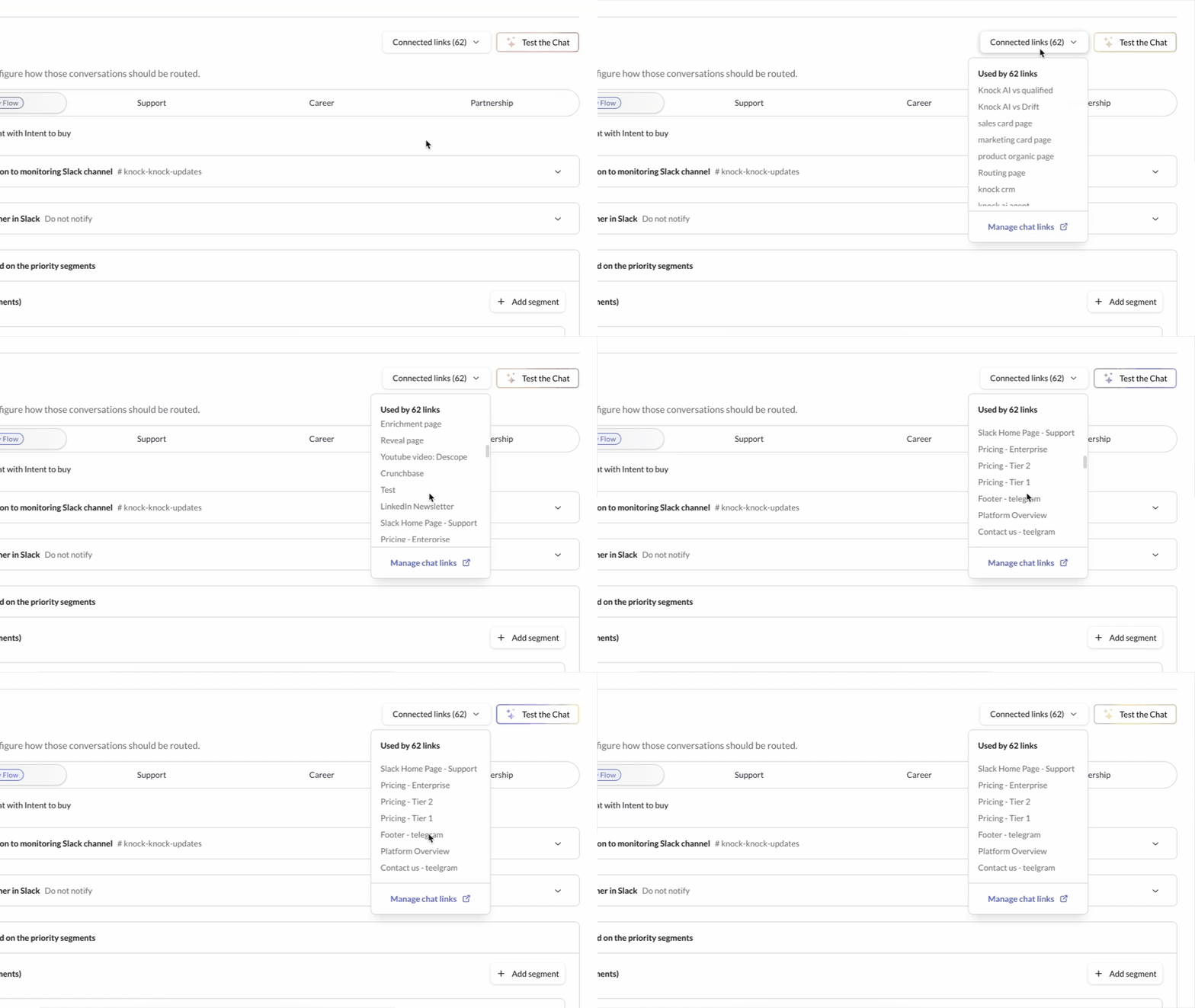
Step 2: Select a Monitoring Slack Channel
Select a Slack channel that receives all chat conversations for this routing, regardless of which segment routes them. This is your team's global observer feed.
- Select an existing connected Slack channel from the dropdown.
- Or click "Create new Slack channel" to add a new channel directly from the dashboard.

Step 3: Enable CRM Owner Assignment & Notification
Knock AI can route chats to the existing owner of a record in your CRM, instead of using your segment rules. This is useful when reps already own named accounts and should keep ownership of any inbound chat from those accounts. The CRM Owner section in the chat routing screen surfaces all CRM user field type properties from your connected CRM - both the predefined owner fields (such as HubSpot Contact Owner or Salesforce Account Owner) and any custom user-lookup fields you've created.
Configuring CRM Owner routing
- Open the CRM Owner section in your chat routing.
- Select one or more CRM user fields. Fields can come from different objects - Contact, Account, or Lead (Salesforce only).
- Set the priority order by dragging the fields up or down. The order matters: Knock evaluates them top to bottom.

How CRM Owner routing is evaluated
Each time a lead starts a chat and the email address is detected, Knock first checks whether the lead exists in your CRM. When the lead exists in the CRM, Knock evaluates the configured fields in priority order, top to bottom:
- The first field with a non-empty owner stops evaluation. Knock skips the segment routing logic and assigns that owner as the Chat Owner.
- If a field is empty, Knock moves to the next field in the list.
- If all configured fields are empty, the segment routing logic runs normally.
When the lead does not exist in the CRM, the segment routing logic runs normally. CRM Owner routing has no effect.
💡 Note: Knock matches leads to CRM records by email or company. Anonymous visitors can't be matched at chat start, so segment routing runs first. If a segment matches before the lead shares an email, CRM Owner routing no longer applies - even if a CRM match would have been found later.
CRM Owner notification
When a lead is linked to an existing CRM record, Knock AI can notify CRM owners in Slack in a private DM. Expand this card and select which CRM user fields trigger a notification. When a chat starts, Knock checks the selected fields and notifies any owners whose fields are non-empty. If the notification target is the same person already assigned as Chat Owner, only one notification is sent. Once notified, the owner can view the chat in real time and join the conversation.

Step 4: Build Segments (your routing building blocks)
- Click + Add segment to add a new segment. Each segment card follows an if/then structure.
- Add Conditions - Define one or more AND conditions using the filter picker. Click the filter name or + Filter to add conditions.
- Route by lifecycle stage - Send leads marked as SQL in HubSpot directly to your senior AEs, while MQL leads go to SDRs for qualification.
- Route by account tier - Use a Salesforce field like Account Tier to send enterprise accounts to a dedicated rep and SMB accounts to a round-robin pool.
- Route by lead score - Use a Marketo lead score field to prioritize high-scoring leads to your fastest-responding reps.
- Choose Routing Choose one of three routing destinations:
Available filter categories:
Category | Filters |
Custom Filters ⭐ | Your team's saved custom filters (editable/deletable inline) |
Contact Info | Device, Lead Location, Page Views URL, Role |
Company info | Company Size, Headquarters, Company Industry, Tech Stack, Funding |
Attribution data | Channel, Source, UTM Content |
Engagement & Intent | Intent Signals |
HubSpot | CRM-synced HubSpot fields |
Salesforce | CRM-synced Salesforce fields |
Marketo | CRM-synced Marketo fields |
Click + Create New Filter to define a brand-new custom filter. Each filter shows a description, example value, and answer type in the right panel of the picker.

New filters you create appear under the "Advanced info" category in your connected CRM's field mapping, ready to be mapped. This section only shows up after you've added at least one filter.

2.1 CRM-Based Conditions
Select any field from your connected CRM (Hubspot, Salesforce, or Marketo) and route leads based on their actual CRM values - in real time, no manual work required. If a lead doesn't have a matching record in your CRM, the segment is skipped and Knock moves to the next one.
Example use cases:
- Human Rep - the lead is routed to a specific rep or a round-robin team. This is relevant when you have a rep owner for each audience type. The agent engages the lead until the rep joins the chat.
- Discovery Agent - anyone in the Monitoring channel can jump in. The first to reply becomes the owner. This is relevant when a group of reps can talk to a specific audience, and the first to reply wins the lead.
- Disqualify - the AI handles the full conversation and updates the chat as rejected. The lead gets a self-service experience. You can still see those chats, and if you decide to join, the status changes to Human discovery.
You can also set:
3.1 Dedicate notification channel - An optional Slack channel specific to this segment. Reps in this channel will be notified only about leads that match this segment.
3.2 Triggered Action - When no rep is available to chat, the agent can offer the lead a next step instead of leaving the conversation open. Choose one of two types:
1. Book a meeting (for example, a demo)
- Select the meeting name, duration, and routing rule.
- The agent prompts the lead to book, and the lead is routed according to the routing rule you selected.
- Optionally, you can hand the meeting to the chat owner instead. If a chat owner has already been assigned to the conversation, they take over from the routing rule and the meeting is booked with them. (toggle ON the “Assign meeting to the chat owner” option)
- Make sure the chat owner has a Google Calendar connected, otherwise the meeting can't be booked with them and it will fallback to the routing rule.
2. Custom action link (for example, signing up for the product)
- Add a link you want the agent to share.
- The agent offers the link to the lead as the next step.

When no rep is available to chat, the agent can offer the lead a next step instead of leaving the conversation open. Choose one of two types:
1. Book a meeting (for example, a demo)
- Select the meeting name, duration, and routing rule.
- The agent prompts the lead to book, and the lead is routed according to the routing rule you selected.
- Optionally, you can hand the meeting to the chat owner instead. If a chat owner has already been assigned to the conversation, they take over from the routing rule and the meeting is booked with them.
- Make sure the chat owner has a Google Calendar connected, otherwise the meeting can't be booked with them.
2. Custom action link (for example, signing up for the product)
- Add a link you want the agent to share.
- The agent offers the link to the lead as the next step.
- Managing segments:
- Drag to reorder using the handle (⠿) on the left of each segment card - order determines priority.
- Use the ⋯ menu on each segment to Duplicate or Delete it.
Step 5: Configure your Fall Back Routing
Below all priority segments is the Fall back routing card. This fires when no segment condition is matched. Configure it the same way as a segment:
- Choose a routing destination (Human Rep, Discovery Agent, or Disqualify).
- Optionally select a Slack channel to notify the team.
- Set a Discovery Agent fallback action for when reps are unavailable ("Set action").
Always configure fall back routing so no lead is left unhandled.
Step 6: Test the Chat Experience
Click Test the Chat to start testing the chat experience. You can see intent detection, collected fields, segment matches, the agent response, qualification questions, and routing decisions in real time. This will not fully replicate a real lead chat because it does not include real-time enrichment data and identification, but it can help you optimize the experience:
- Add or improve FAQ answers if the agent response is not good enough
- Improve custom field configuration if the qualification questions are not clear enough
- Change segment order if qualification does not follow the expected order
- Add or improve the segment action setup if the agent does not suggest it correctly

FAQs
On this page
- Set Up Advanced Chat Routing in Knock AI
- What Chat Routing Does (at a glance)
- How Chat Routing Works in Knock AI
- How to Set It Up (step-by-step)
- Step 1: Access the Chat Routing Screen
- Step 2: Select a Monitoring Slack Channel
- Step 3: Enable CRM Owner Assignment & Notification
- Configuring CRM Owner routing
- How CRM Owner routing is evaluated
- CRM Owner notification
- Step 4: Build Segments (your routing building blocks)
- Step 5: Configure your Fall Back Routing
- Step 6: Test the Chat Experience
- FAQs